A deeper way to prepare for UPSC,
built for a higher purpose.
Adhitam AI is a UPSC Civil Services prep companion that helps you decide what to study, what to revise, and what to practice next — around the real UPSC syllabus.
“Not just to clear an exam,
but to build a better Bharat.”
Different starting points.
One clear way forward.
Whether you're beginning your first serious attempt, balancing preparation with college or work, or trying to bring structure back to an existing routine, Adhitam AI helps you work from where you are.
College Students
Build your foundation without letting preparation get lost between classes, assignments and everything else.
Working Professionals
Make limited hours count with a study routine that fits around your day.
First-time Aspirants
Start with clarity instead of trying to figure out the entire syllabus at once.
Self Learners
Bring study, revision and practice into one disciplined system.
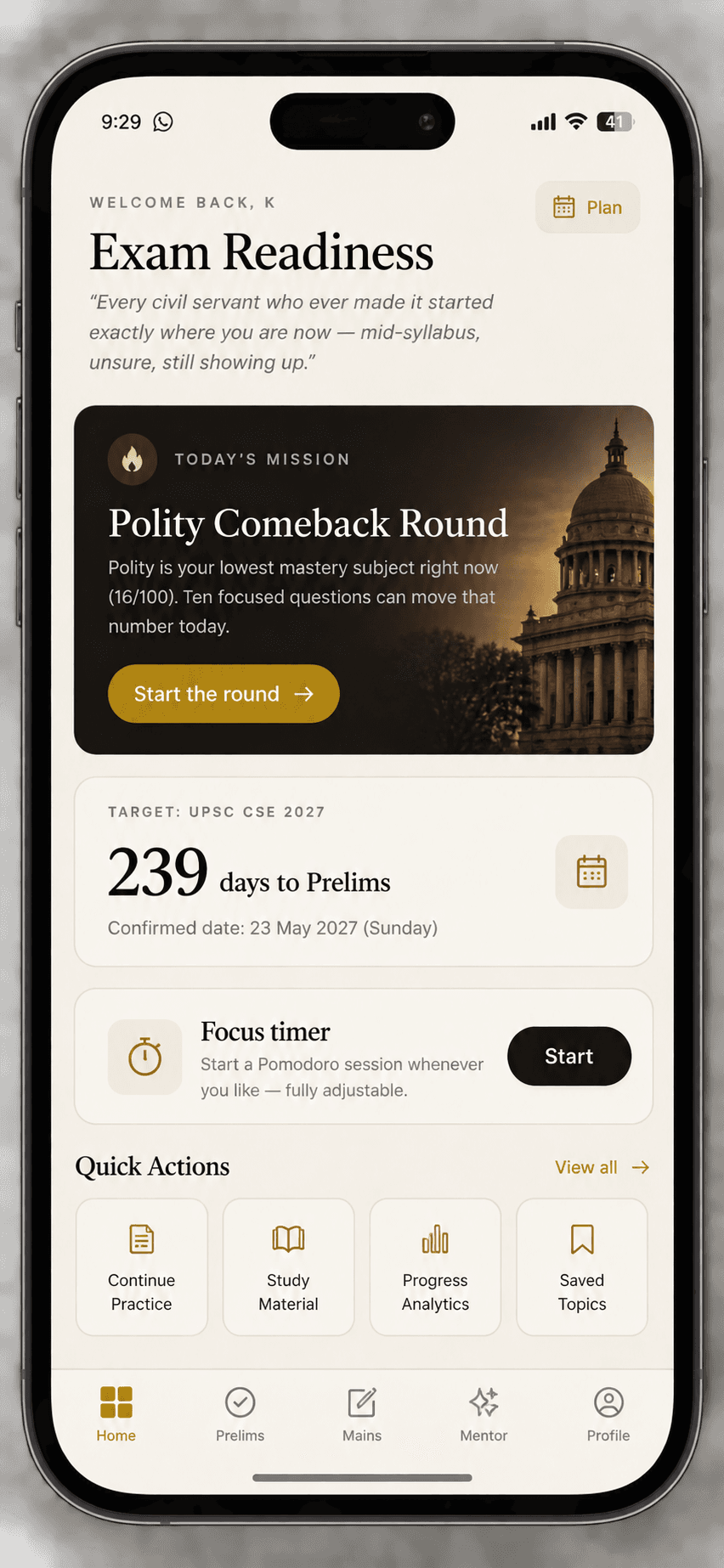
Personalised Daily Missions
Tell Adhitam your attempt year, available time, and optional subject. Preparation is organized into clear daily missions of study, revision, and practice.
The hardest part isn't always studying.
Sometimes it's deciding what deserves your time.
UPSC gives you an enormous syllabus, years of previous questions, constantly changing current affairs and limited hours in the day.
The result is familiar: too many resources, unfinished plans, revision that keeps getting postponed, and no clear sense of what needs attention next.
Adhitam AI is built around that problem.
Know What to Study
ClarityStart each day with a clear next step.
Know What to Revisit
RetentionBring important topics back before they fade from memory.
Know What to Practice
Exam ReadinessUse questions and writing to turn study into preparation.
Your daily UPSC study plan,
set for you.
You shouldn't spend your best study hours deciding what to study next. Tell Adhitam your attempt year, optional subject and available time, and your preparation can be organized into a daily mission.
From the first chapter
to the final revision.
UPSC preparation becomes difficult when subjects feel like disconnected piles of information. Adhitam brings subjects, notes, questions and practice into a structure built around the examination.
Explore Subjects→Polity
Constitution · Governance · InstitutionsModern History
Freedom Struggle · National MovementAncient History
Culture · Society · Art & ArchitectureGeography
Physical · Human · India & WorldEconomy
Indian Economy · Budget · SurveyEnvironment
Ecology · Biodiversity · Climate ChangeScience & Technology
Space · AI · Defence · DevelopmentsEthics
Case Studies · Thinkers · IntegrityArt & Culture
Visual Arts · Performing Arts · LiteratureInternal Security
Cybersecurity · Borders · Emerging ChallengesInternational Relations
Bilateral Ties · Treaties · Multilateral InstitutionsSociety
Social Issues · Diversity · GovernanceEssay
Themes · Structure · ArgumentationCSAT
Comprehension · Reasoning · Quantitative AptitudeRevise before
you forget.
Reading something once feels productive. Remembering it when the question appears is what matters. Adhitam uses your preparation and practice history to bring topics back into your routine when they need another look.
Smart Sequencing
Your preparation is ordered around the syllabus, progress and what needs attention next.
Spaced Revision
Important topics return at planned intervals instead of waiting for you to remember to revise them.
Weak-Area Focus
Topics where you're struggling get another opportunity for practice and revision.
Doubts answered
the UPSC way.
Getting an answer isn't enough. You need an explanation you can understand, connect to the syllabus, and use in preparation.
Ask a question, clarify the concept, explore the relevant context, and go deeper when something doesn't make sense.
Kesavananda Bharati v. State of Kerala (1973)
The Basic Structure Doctrine holds that Parliament's power to amend the Constitution under Article 368 does not extend to destroying its fundamental structure. The principle emerged from Kesavananda Bharati v. State of Kerala (1973).
Content-Aware Answers
Explanations built around the question you're asking.
Structured Explanations
Start with the core idea, then go deeper.
Relevant Examples
Make difficult concepts easier to understand.
UPSC-Focused Context
Keep learning connected to the exam.
Write. Review.
Improve.
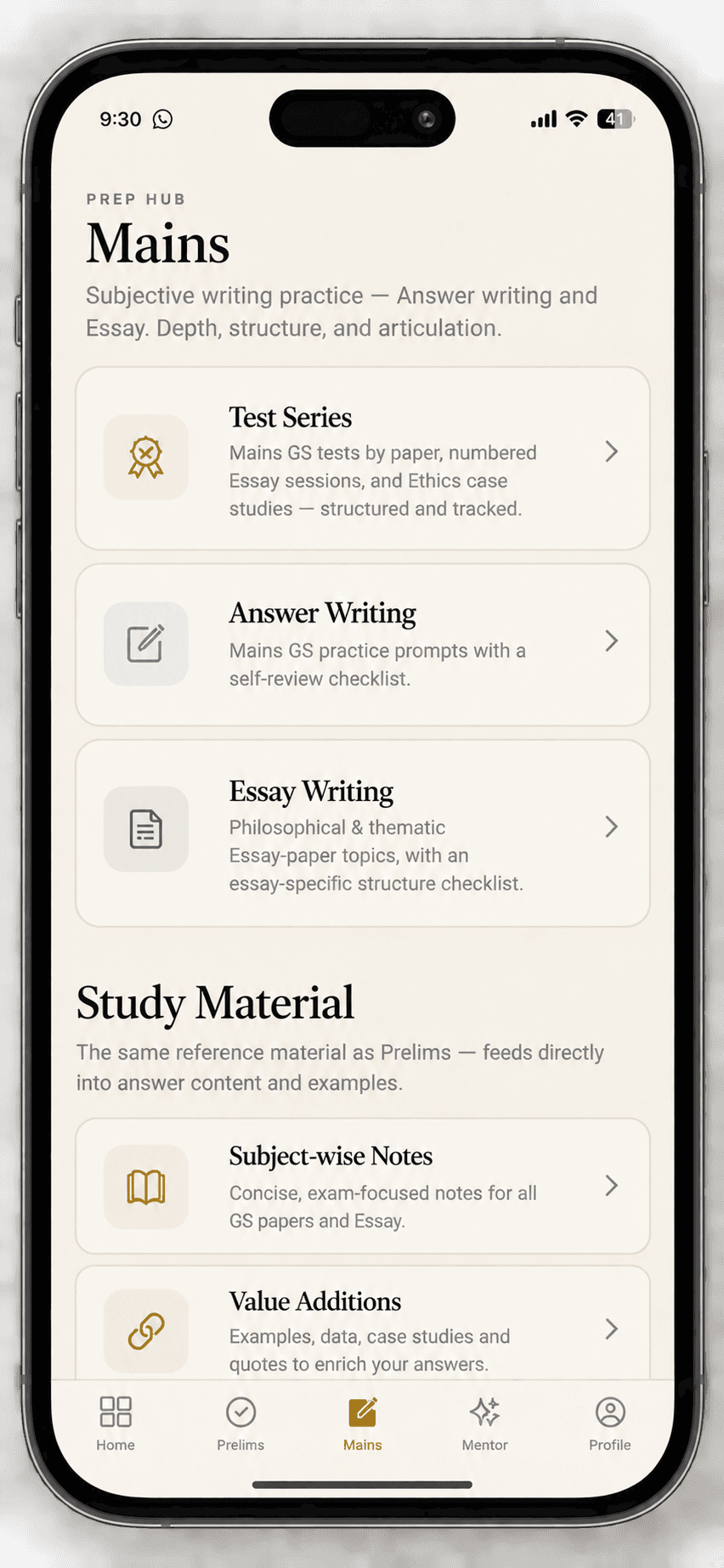
Knowing the answer and writing the answer are different skills. Practice within the limits of the exam, review how you structure your thoughts, and improve with every attempt.
Structure & Introduction
Understand the demand of the question and begin with a clear direction.
Multi-Dimensional Body
Build arguments across relevant constitutional, social, economic and policy dimensions.
Actionable Conclusion
End with a practical way forward rather than simply repeating the argument.
Practice what UPSC
actually asks.
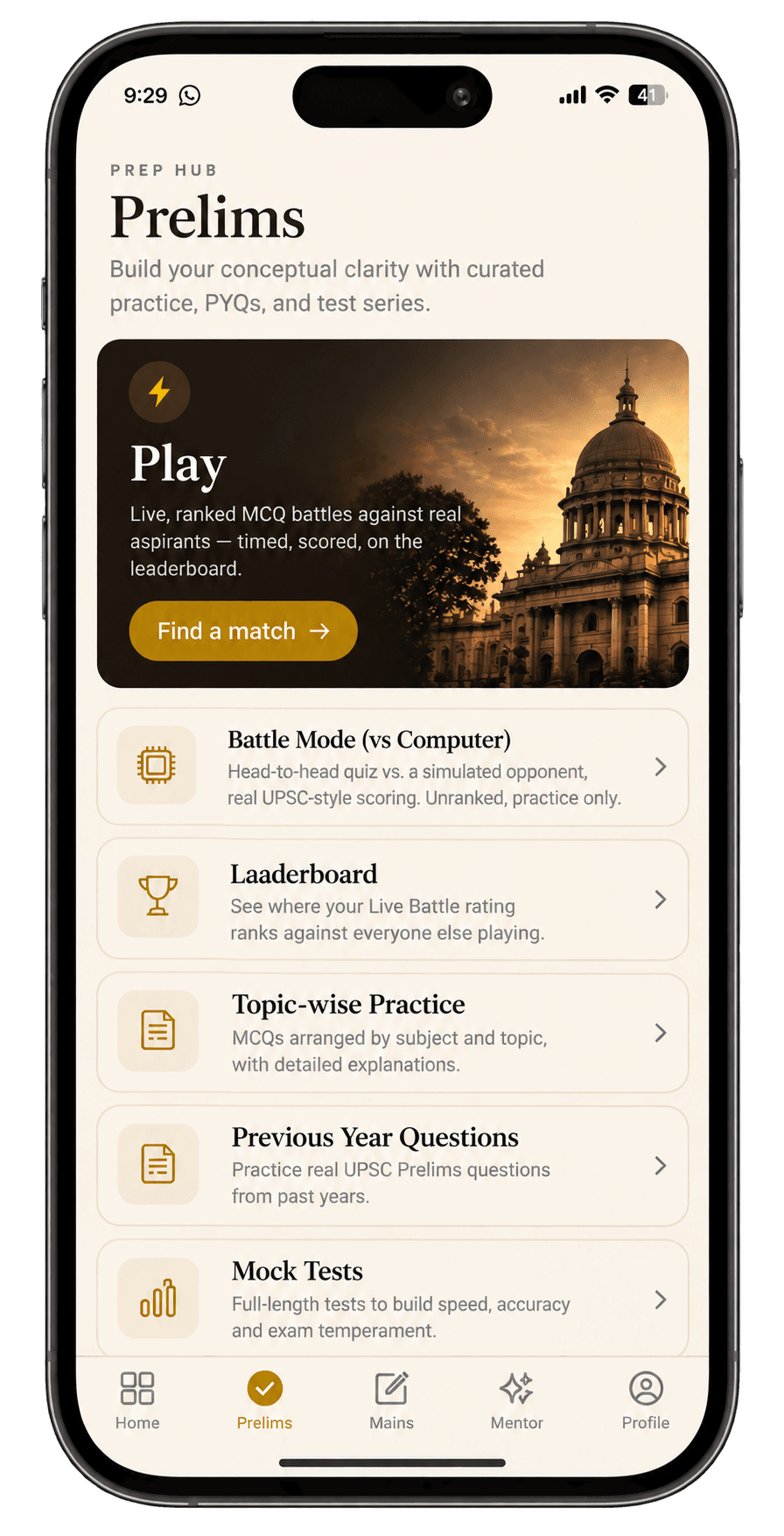
Don't wait until the end of the syllabus to test yourself. Use PYQs and topic-wise practice to understand how concepts become questions — then use mocks to build speed and consistency.
Topic-wise Practice
Practice by subject and topic instead of solving random questions.
Previous Year Questions
Study the questions that have already shaped the examination.
Full-length Mocks
Put your preparation under realistic test conditions.
Detailed Analysis
See where your answers hold up and where they need work.
Current affairs,
mapped to the syllabus.
You don't need more news. You need to know which news matters, why it matters, and where it fits in your preparation.
Daily Updates
Stay informed without getting buried in information.
Exam-Focused Analysis
Understand the issue beyond the headline.
Static Linkages
Connect current developments with the concepts you're already studying.
More than a preparation app.
Most aspirants don't need another place to collect resources. They need a system that helps them use their limited time well.
Adhitam brings planning, study, revision and practice into one preparation flow — so your effort goes toward building understanding, recall and exam readiness.
UPSC rewards understanding. Build concepts before chasing tricks.
A sustainable routine beats a perfect timetable that lasts a week.
Reading is only one part of the journey. Study, revise, practice, review, repeat.
“Not just to clear an exam, but to build a better Bharat.”
Frequently Asked Questions
Know what to study.
Know what to revise.
Keep moving.
Your UPSC preparation doesn't need more noise. It needs a clearer next step.